Visualizzazione post con etichetta China. Mostra tutti i post

mercoledì 29 novembre 2017

The Post-Western World and the building of a parallel international order


Risultati immagini per postwestern world stuenkel


In his book Post-Western World. How Emerging Powers are Remaking Global Order, Oliver Stuenkel introduces some innovative arguments regarding the future of world politics from a quite uncommon perspective for Western mainstream analyses. The chief thesis of the research claims that the understanding of the creation of today’s international order is limited, since it depicts a post-Western world from a closed-minded Western-centric standpoint. In this context, non-Western actors are barely perceived as constructive rule-makers and institution-builders, because the West is widely conceived as the sole actor entitled to enhance the norms by which the international system is disciplined. However, Stuenkel suggests that the study of the future’s world order needs to undertake the inevitability of a bipolarization between the United States and China or even of a multipolarization due to the emerging of the BRICS countries. The end of the unipolar world – which represents a historical fact – implies a more overarching international analysis that overcomes the traditional Western-centric perspective and a more balanced reading of the distribution of global power. The chief aim of Stuenkel’s work is to show on one hand that most observers – both Western and anti-Western – tend to exaggerate the role the West has played in the past and, on the other, to discuss on how to adapt to a multipolar world order.   
The book is organized in six chapters. The first chapter considers the origins of Western-centrism from a historical outlook. Specifically, it describes the nature of global order prior to the rise of the West, claiming that an international order was already in place before; it analyzes how Europe began to advance and rapidly overcome other actors starting from the 16th century, ultimately dominating the world four centuries later; and it evaluates how Europeans – and Westerners in general – believe that Westernization and modernization are synonyms.
The second chapter deals with the rise of the rest and with the likely end of the unipolar system. The principal statement here is that in the coming decades the world will face a condition of “asymmetric bipolarity” in which the United States will keep their leading position in terms of military power, whereas China will embody the world’s first economy. Nevertheless, the author questions whether this kind of bipolar system will be peaceful, durable and stable, but he also rejects the idea – often shared in the West – that the imminent post-unipolar world will be necessarily chaotic and instable. The third chapter examines soft power. After highlighting that soft power uses attraction and persuasion rather than force and coercion in foreign policy, and that its allure relies on a country’s culture, political ideals and policies, the author states that emerging powers are seeking to transform hard power into soft power by implementing three key areas: cultural diplomacy, international legitimacy/agenda-setting capacity, and attraction of each society.
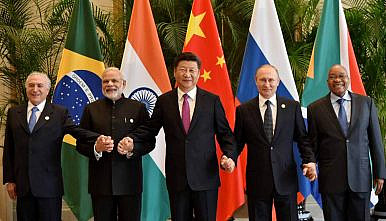
The fourth and fifth chapters illustrate the main international initiatives and institutions proposed by non-Western countries – particularly China – aimed at crafting a parallel global order. These institutions and international regimes are divided into several sectors: finance, trade and investment, security, diplomacy, and infrastructure. The finance sector includes the analysis of the Asian Infrastructure Investment Bank (AIIB), the BRICS-led New Development Bank (NDB), the BRICS Contingency Reserve Agreement (CRA), the global infrastructure to internationalize the yuan, China International payment system (CIPS), China Union Pay, the Shanghai Global Financial Center (GFC), the Universal Credit Rating Group, the Chiang Mai Initiative Multilateral (CMIM), the ASEAN+3, and the ASEAN+3 Macroeconomic Research Office (AMRO). The trade and investment sector analyzes the Regional Comprehensive Economic Partnership (RCEP) and the Free Trade Area of the Asia Pacific (FTAAP). The security sector deals with the Conference on Interaction and Confidence Building Measures in Asia (CICA), the Shanghai Cooperation Organization (SCO), and the BRICS national security advisors (NSA) meeting. The diplomacy sector includes the BRICS Leaders Summits, the BRICS and IBSA working groups, and the Boao Forum for Asia (BFA). Finally, the infrastructure sector introduces the projects of the Silk Road Fund/One Road-One Belt (OBOR), the Nicaragua Canal, and the Trans-Amazonian Railway.
Finally, the sixth chapter draws some conclusions on the coming post-Western world. A key thesis by the author is that non-Western actors do not seek to undermine Western institutions and create a new world order, but rather they wish to forge parallel institutions that emulate Western leadership. Moreover, emerging powers do not question the foundations of Western liberal order, and agree with issues such as international institutions, cooperative security, democratic community, collective problem solving, shared sovereignty, and the rule of law: in fact, all these elements are necessary for rising powers to develop economically.            
The key arguments of the book are the following. First, a Western-centric worldview leads to underestimate the role of non-Western actors have played in the past and play in contemporary international politics, but also the constructive role they are likely to play in the future. The book argues that a post-Western order will not necessarily be more violent than today’s global order.
Second, the economic rise of the rest, specifically China, will allow it to enhance its military capacity and it will inevitably entail an increase of its international influence and soft power – since soft power is easy to generate from a large hard power base.
Third, emerging powers are crafting a parallel international order, with several institutions and international regimes that represent an alternative to Western-led ones. The book argues that, rather than directly confronting existing institutions, rising powers – primarily China – are quietly building a parallel global order that will initially complement today’s international institutions.
Finally, the creation of new parallel institutions is the main strategy that non-Western actors use to better project their power. This alternative order is already in the making, but its structures do not emerge because China and others bear new ideas on how to address global challenges, but rather they create them to project their power, emulating what the West has already done before. The book claims that, as part of a heading strategy, China-led emerging powers will continue to invest in existing institutions and embrace most elements of today’s “liberal hierarchical order”, but they will seek to obtain the “hegemonic principles” so far only enjoyed by the United States. The creation of several China-centric institutions will allow China to embrace its own type of competitive multilateralism, picking and choosing among flexible frameworks, in accordance with its national interests, thus slowly institutionalizing its own exceptionalism and enhancing its policies autonomously by becoming increasingly immune to Western threats of exclusion.
In conclusion, Oliver Stuenkel depicts an interesting future scenario by using lenses that see beyond Western-centric rhetoric, giving for granted the rise of a post-unipolar – and thus post-Western – global order. Being a Brazilian scholar – therefore a citizen of one of the BRICS –, the author points out a very detailed analysis of the main issues that emerging powers will have to deal with, which are often miscalculated in Western academic and intellectual environments. Overall, his book is a valuable and appreciable tool to understand the perception that the non-Western world has of itself and of the West, and, mostly, a useful guide for the West to not overestimate itself and underestimate the rest.     

Risultati immagini per postwestern world stuenkel


References:

O. Stuenkel, Post-Western World. How Emerging Powers are Remaking Global Order, Cambridge: Polity Press, 2016. 

domenica 1 febbraio 2015

Kaplan and the “revenge of geography”. A survey on the geopolitical evolution of international relations. Part Two.


If the first part of Kaplan’s book focuses its attention on the theoretic geopolitical models of the past, the second and third parts describe specific present-day international scenarios, exploring them through the pattern pointed out before.
The first chapter of Part 2 is dedicated to the European Union. After proposing some general reflections over the present status of the EU, Kaplan wishes to analyze more accurately the influence of Asian invading hordes throughout European history, along a line of continuity that binds the first Cimmerian invaders of the II millennium B.C. to the final Mongolic ones of the XIII century A.D. Once again, the author underlines the impact of climate and geography for Europe’s development and rise. The landscape of the European continent abounds with mountains, forests, productive fields, jagged shorelines and natural harbors and docks. The multiplicity of European civilization and the variety of the peoples that here dwell hinge upon the natural richness and diversity of the continent’s geography. Diversity, dynamism and particularism have been the key words for the birth of a common “idea of Europe”, which still holds the record of having bestowed the highest contributions to world civilization. The notion of Europe as a sole political unity, as the EU now pretends to be, dates back to the time of Charlemagne, the founder of the Holy Roman Empire. After Charlemagne, other statesmen endeavored to unify Europe into a single polity once again: the Hohenstaufen emperors, emperor Charles V of Hapsburg, Louis XIV of France, Napoleon, Kaiser Wilhelm and, ultimately, Adolf Hitler: shortly, all of them failed. The European integration process, started with the Treaty of Paris (1951) and the Treaties of Rome (1957), aims at a similar purpose: to forge a political unified Europe through economic ties. Indeed, there are some resemblances between Charlemagne’s Europe and the current EU; for instance, the present EU ruling regions stand where once laid the core lands of the Frankish Holy Roman Empire of old: Burgundy, Flanders, the Netherlands, the Rhineland, Alsace, Lotharingia, Lombardy and Catalonia. Undoubtedly, in the contemporary EU the central, northern and northwestern regions overlay supremacy over the southern (Mediterranean), southeastern (Balkan) and eastern (Eastern European) ones. To be more precise, within this general pattern Germany enjoys the status of hegemonic EU power. Besides, the Balkan countries play a crucial role: first, it is towards these regions, along with the others in Eastern Europe, that the European Union wills to expand and to establish her control; then, the Balkan whole range is just outside Mackinder’s Eurasian Heartland and lays right on top of Spykman’s Rimland. In this context, the roles of Greece and of Turkish Eastern Thrace are particularly significant.
The book then continues speaking of Russia. Actually, Russia is to consider mainly as a land power. By so being, she naturally expresses all of the uncertainties and insecurities typical of land powers that are usually landlocked or semi-landlocked. Historically, Russia was a semi-landlocked country until the XVIII century: in fact, as we know, the Arctic Ocean froze during the winter and trades towards Europe or Eastern Asia stopped. This geographical condition, as well as the need to protect the frontiers, gave birth to Russian territorial expansionism. The imperatives of Russian historical foreign policy were two: on one hand, that of defending the steppes from the ever raids of the nomadic horse-riding Turkish-Mongolian tribes (the continuous struggle between Cossacks and Tatars exemplifies the matter), and on the other, that of seeking for warm waters from which carrying on trading during wintertime. Interestingly, Kaplan believes to find the spring of both tsarist autocracy and soviet totalitarianism in the climate and landscape of the Russian country, showing once more how geographical determinism affects the evolution of political systems. Summarizing Russian history, the author points out the prominence of Ukraine, whose relevance is already contained in the name she bares: “borderland”. The reason for Ukrainian past and present territorial crises rely on the fact that this crammed flatland lays exactly in-between the Eurasian Heartland and the European Rimland. Moreover, the author cites once again the rivalry between tsarist Russia and the British Empire for the control of Eurasia during the nineteenth century also known as “Great Game” or “Tournament of Shadows”. The Russian strategic interest to reach the warm waters could de facto threaten the British communication lines with the Indian Raj and with the English areas of influence in the Orient. As for the conquest of Siberia, her climate and natural conditions implied the birth of a coercive and centralized kind of government. The building of railways helped joining the vast Siberian widths, though suggesting a sense of unsafety and insecurity typical of Russian historical mentality. In Siberia, rivers play a relevant role: the Yenisei splits Western from Eastern Siberia and the Lena Eastern Siberia from the Russian Far East; meanwhile, the Ussuri forms the natural border between the Russian Far East and Chinese Manchuria. The conquest of Siberia obliged Russia to participate to the Pacific geopolitical contest, leading her to compete with Japan, China and, later, the United States for the hegemony over the area: think of the wars fought by tsarist Russia against Qing (Manchu) China or against the Japanese Empire of the Rising Sun. When the Soviet Union replaced imperial Russia, the Bolsheviks had to face the evidence that a land power always suffers the threat of an attack on its outskirts: the gruesome years of the civil war and of foreign interventionism (1918-23) reestablished the difficulty of defending the Russian borders. Bolshevik imperialist realism was able enough to consider moving the back the capital to Moscow rather than Saint Petersburg, a core region from which the Eurasian control would be easier to foster. Later, the United States perceived the birth of the great Soviet empire onto the ashes of the shattered German Third Reich as the happening of Mackinder’s prophecies on the control of the World-Island (i.e. Eurasia). Indeed, after World War 2 appeared two main superpowers: on one side the USSR, that almost encompassed the whole of Mackinder’s Heartland, and on the other the United States of America, that embodied the perfect example of Mahan’s great sea power. Since then, the Eurasian Rimland (including the Greater Middle East, Western Europe and Southeastern Asia) would feel jeopardized both by the spread of Soviet land power and by the pressure of American sea (and air) power. After the USSR’s demise and the outburst of newly discovered nationalistic feelings amongst the variegated former Soviet subjects, vulnerability was again Russia’s keyword, deriving mainly from the unbalanced ratio between Russian demographic rates and geographic extensions of the country. Things have changed now in Eurasia. It seems to be that China is gaining always quicker a hegemonic role on the Eurasian continent. So being things, should Russia focus her attention more on the Eurasian Heartland or on her fringes like the European peninsula and the Pacific Rim? What would Russia need to attract back to her former USSR subjects? Unfortunately, Russia still needs to face the never-ending issue of being, in fact, borderless. Furthermore, Ukraine plays a strategic role for the relationships between the European Union and the Russian Federation: it is throughout the Ukrainian flatland that superpowers currently confront each other and within the present crisis, as foreseen by Brzezinski, Poland could play a pivotal role, for better or for worse. Paradoxically, the Soviet subdivision of Central Asia survived to the downfall of the USSR; despite feeble political movements like pan-Turanianism or pan-Iranianism, Central Asian republics are relatively stable though their ethnic composition does not often coincide with the borders of the existing sovereign Turkestan States. For instance, Kazakhstan, a significant portion of Mackinder’s Heartland, finally returned to its native inhabitants. To conclude the chapter, the author dedicates some space to the Shanghai Cooperation Organization (SCO), described as a group of Eurasian powers in anti-US fashion whose effectiveness over international politics is still uncertain and in progress. 
The chapter dedicated to China opens with Mackinder’s view over this demographic and geographic giant. China is even more threatening than Russia, because not only does the country possess direct access to the Eurasian Heartland and its resources, but in addition to this enjoys a strategic frontal position towards the Pacific Ocean: this makes China a potential blend of land power and sea power and gives full meaning to her Mandarin name of “Middle Kingdom”. Only now, is this double role of Chinese power arising clearly and becoming a worrisome truth. The concept of Inner Asia, including the lands of Manchuria, Mongolia, Eastern Turkestan and Tibet, appears to be of fundamental geopolitical interest when considering the huge Chinese landscape. In Eastern Turkestan dwell the Muslim Turkic Uighurs that have been continuously struggling for secession from China, finding moral support in other Turkic nations. In Inner Mongolia live the Mongols, unfairly separated by their kinsmen of Outer Mongolia. In Tibet are the Lamaist Tibetans who still oppose as they best can Beijing’s communist regime, attempting to call back from his Indian exile the Dalai Lama.  Finally, Manchuria, a land from where the last Chinese imperial dynasty originated (the Manchus), represents a border region that has been historically claimed by Chinese, Russians and Japanese (think of the birth of the Japanese puppet-State of Manchukuo in 1932). China still suffers in remembering her dishonorable historical break up between the nineteenth and twentieth century, when European powers snatched coercively Chinese territorial concessions, trade deals and juridical capitulations, before the Japanese would start their own continental expansion against China. Beijing conceives its international affairs as a mean to avoid any new possible Chinese loss of sovereignty, reflecting it on its relationships with Taiwan and Hong Kong. Indeed, Russia has to fear the risk of a re-population of Eastern Siberia by Chinese pioneers and settlers, considering that the demographic ratio between Russians and Chinese in the Far East is completely unbalanced making future scenarios in the area uncertain. Historically, the Nixon administration, with the aid of Kissinger’s advice, took the advantage of both Brezhnev’s detent strategy towards the US and of the Sino-Soviet split in order to open diplomatically to communist China within the framework of a truly realistic strategy, devoid of ideology and emotionality. China has been opposing the ethnical diversity within her territory by colonizing the sensitive zone, say, Tibet or Xinjiang, with ethnic Hans. However, the real grand strategy of a Greater China would consist in penetrating Mackinder’s Eurasian Heartland. A Greater China implies a Chinese preponderant over Afghanistan, Pakistan, Central Asia, Southeastern Asia and the Chinese First Island Chain (which, going from north to south, comprises Japan, the Ryuku Islands, the so-called half-island of the Korean Peninsula, Taiwan, the Philippines, Indonesia, and Australasia). As we can imagine, the very idea of a Greater China, with her preponderant influence over almost half of Asia, finds a natural rival in the parallel Indian rise. Evidently, the rivalry between China and India will be a leitmotiv for the future international internationals, among which the Dalai Lama’s exile issue is just the tip of the iceberg, if not a mere casus belli. Besides the enmity for Tibet, an Indo-Chinese “Great Game” is taking place, embracing countries like Nepal and Bhutan (the two Himalayan buffer States) on one side and Pakistan, Bangladesh and Sri Lanka on the other. The projection of sea power over the city-State of Singapore expresses a risk of a Chinese dominion over the Indian and Pacific Oceans through the trade routes that track the Strait of Malacca. The international relations in the Far East cannot neglect the significant role that North Korea covers for being the pivot of East Asia: the possible reunification of the Korean peninsula under a single State could alter the entire balance of power in Eurasian Eastern Rim. As said above, China is leading a double penetration both in Mackinder’s Heartland and in Spykman’s Rimland: her new task consists in transforming a traditional continental power into a mixed land-sea power. China is trying to absorb the nature of sea power also by building a mighty fleet but still lacks of self-confidence in rushing towards the oceanic challenge. Anyways, through its projection of power over all Eastern Asia, Beijing is newly shaping the Western Pacific’s geographic strategy and altering the balance of power of the region: this could lead in the near future to the need for reconsidering the diplomatic alignments and the strategic alliances for all actors here entangled.
As far as India is concerned, Mahan and Spykman considered this country’s position as critical for being a Rimland power naturally oriented towards the Middle East and China from her maritime subcontinental position. As we have already seen, Eurasia consists of a landmass, which encompasses the former USSR, and greatly populated fringes (Europe, India, Indochina and China): amongst the latter, the Indian subcontinent represents one of the most heavily populated and various from an ethnic, linguistic and religious point of view. Mackinder found India’s vulnerability on her northwestern frontier, from which historical invasions came crossing the Khyber Pass. Describing India’s landscape, her mainland embodies two geographical facts: it appears to be a standing-alone subcontinent on one side, and a vibrant extremity of the Greater Middle East on the other. Moreover, from a linguistic and ethnic point of view India appears to be as split into two areas: the Indo-European north and the Dravidian south. Unlike China, India grew as a democratic and pluralist political system thanks to the British rule of yore, which commenced through the creation of small English footholds on the Indian shores. Britain introduced in India the parliamentary mentality, the common-law juridical system, the European administrative model and, of course, the English language. Thanks to British-built railways, the English governors managed for the first time in history to unite the Indian subcontinent into a single polity. Besides, the countries that neighbor India present a lack of geographical coherence. Pakistan was hastily born in 1947 for unraveling the Indian Muslims from the Hindu majority. Bangladesh was born in 1971, seceding from Pakistan for political reasons. Nepal and Bhutan symbolize two buffer states between India and China. The Afghan borders descend from the Russo-British imperial rivalry in Central Asia (think of the Wakhan Corridor, that currently separates Tajikistan from Pakistan, conceived to keep a bumper zone between the Russian and the British empires). Indeed, Afghanistan holds a strategic position for being a buffer between the Iranian Plateau, the Central Asian steppes and the Indian Subcontinent; verily, it is the crossroad of the entire Asian continent. Today, the Eurasian Heartland is vast landscape where the interests of Russia, China, India and Iran intertwine and where the Central Asian strips, including Afghanistan, play a major role. A stable Afghanistan could become the hub of Eurasia, and all nearby countries would benefit from that. Actually, after the Greater Middle East region, the Greater Indian subcontinent represents one of the least stable geopolitical areas in the world. One of the reason for the somewhat tarnished relations between India and China relies on the fact that the Chinese regime upholds military and political support to India’s regional rivals, significantly Pakistan: India feels somehow surrounded by China. The issue of Kashmir, a land partitioned between Pakistan, India and China, keeps the tensions high amongst them.
For what concerns the Middle East, this pan-region represents a vast quadrilateral where Europe, Russia, Asia and Africa intersect: with the Mediterranean Sea and the Sahara Desert to the west; the Black sea, the Caucasus, the Caspian Sea, and the Central Asian steppe-land to the north; the Hindu Kush and the Indian Subcontinent to the east; and the Indian Ocean to the south. One of its main distinguishing features is that it lacks of a single State that has hegemony over the area. In fact, which country should gain the rule of the Middle East? Turkey has a vast population, but is not Arabic. Iran has a vast population too, but it neither Arabic nor Sunni. Saudi Arabia controls the Holy Shrines of Mecca and Medina, but has a small population. Egypt has a large population, but its African location turns it away from the Asian Near East. The weakness of all the Middle East depends on the lack of unity among its countries. Pan-Arabism once embraced the idea of unification of all Arab nations, but even if it had reached the goal, countries like Turkey, Iran, Afghanistan and Pakistan would have stayed out from the union. Within the Middle East, there are three main ethnic strains: the Arab, the Iranian, and the Turkic: each of them declare its respective superiority over the others. The Arabic Islamic world divides in three parts: the Maghreb (Northern Africa), the Mashreq (the Near East) and the Khalij (the Arabian Peninsula and the Persian Gulf). All of the Mashreq is instable mainly due to European colonization (keep in mind the British and French mandates over the former Ottoman Near East after World War 1) on one hand and the presence of the Zionist State of Israel on the other. Furthermore, Wahhabism influences greatly the Saudi Arabian view of politics and religion. Its fanatical interpretation of the Quran originated from the central Arabic region of Najd where the society’s backbone consisted in camel-based nomadism; thus, Najd represents the core of Wahhabi rule and Saudi sovereignty. As for Iran, it embodies the Middle Eastern universal juncture, just as the Middle East incarnates the quadrilateral of the World-Island (Eurafrasia). Can Iran become a new geographical pivot despite its reactionary theocracy and its nuclear enrichment program? Though Iran is much smaller than India and China, or Russia or Europe for the matter, it is merely because it is in possession of the key geography of the Middle East in terms of position, population and energy resources that is fundamental to global geopolitics. Indeed, the originality of the Iranian revolution of 1979 lies in the alliance between the clergy and the Islamist intelligentsia. The Iranian state has been stronger and better organized than any others in the greater Middle East, save for turkey and Israel, and the Islamic Revolution did not dismantle the Iranian State, but, rather, attached itself to it. It is also true that the somewhat suffocating Shiite clergy of Iran dispirits an allure of Central Asian, Caucasian or Arabian Muslims towards the country. In addition, Iraq’s destiny is deeply dependent on that of Iran, being a country that hosts a numerous number of Shiite Muslims. Undoubtedly, for better or for worse, Iran will affect the Eurasian future fate. Also, what to say about Turkey? Turkey’s geographical nature is that of a natural land bridge, or almost of an island: it links the Middle Eastern core land with the southeastern European gate. In being one of the most secular and open-minded nations among the Islamic world, Turkey has the opportunity, due to her Kemalist past, to interact effectively with the European nations and the West. Although the current Turkish leadership seems to yield somehow from the Kemalist laicism, the overall positive condition of Turks, the concrete respect for human rights and the membership within NATO make Turkey a good interlocutor for the US, and who knows if this Islamic overpopulated republic will one day join the EU. For sure, Turkey still projects a relevant shadow-power both in the Balkans and in Caucasia, and stands as a gifted opponent to Iranian hegemony over the Muslim world.
Finally, Kaplan dedicates Part 3 of his book to the Americas, particularly North America. Mackinder calls the outlying area that includes the Americas the Outer Crescent in order to differentiate it from the Marginal Crescent or Rimland. As we already know, the entire North American continent comprises the most crucial of the continental satellites around the World-Island and a land from which sea power and air power projects over the Marginal Crescent. Kaplan introduces here some thought-provoking ideas. He highlights that the United States, having dropped down the material barriers towards the Canadian border, stay vulnerable in their southeastern frontier with Mexico. The US own an Anglo-Protestant backbone that the Hispanic Catholic immigration from Mexico may put at stake in the future. American Protestantism closely aligns with nationalism; it helped releasing a typical American mentality based upon dissent, individualism, republicanism and patriotism. This entire scale of values, as well as the white race predominance, is endangered by the risk of a Mexican “Reconquista” of the American southeastern States due to the surprising demographic augmentation of Hispanic individuals and to a difficult containment of illegal immigration from Mexico. Now, Kaplan’s suggestion is very simple and smart: he asks why the US government should worry so much of starting expensive wars in far lands like Afghanistan, entangling in extremely complicated crises and circumstances, when it would be so more useful to fix the problems on the southern border. In other words, the United States of America should care less of foreign countries that lay out of their territorial range and should instead focus the attention on its own mainland. Not only would this political strategy bring closer the public opinion of all those extra-American countries where the US somehow intervened, but also it would utterly mean to uphold the very American-born Monroe Doctrine.                                                                  

martedì 27 gennaio 2015

Export subsidies: are they truly useful for a country’s commercial policy?

The subsidies to exportations are a tool of commercial policy adopted by the economic policymakers of a State in order to promote and boost the exports of national goods and services towards foreign countries and economies. The contemporary multilateral commercial system, as evolved within the framework of the GATT (General Agreement on Tariffs and Trade) and, since 1995, within that of the WTO (World Trade Organization), considers subsidies to exports as conflicting with the very principles of free trade and therefore discourages their utilization along with other measures (duties, quotas, voluntary export restrictions) meant to alter the natural interplay of international commerce.
As soon as an exporting country decides to import its commodities in another, this will deeply influence the economic indicators of both, with significant consequences on the level of prices, on the output of enterprises, on the economies of scale, on the aggregate demand, on the balance of trade and mostly on the overall domestic product.
First of all, we must highlight that the export subsidies produce relevant effects on the country that receives the exports, thus being the importing one. These effects can be either positive or negative. Starting with the negative ones, in a perfectly competitive market the amount of the imported goods will affect the level of prices. Indeed, if the price of the imported good is lower than the domestic price for a similar good the enterprises will accordingly have to align their prices to it, however this is often unbearable because of the high production costs especially whether the enterprise uses costly specialized workers or sophisticated technologic equipment. Consequently, the importing of foreign assets can lead to a recession for the domestic and local enterprises that ultimately spawns bigger unemployment. Moreover, a particularly competitive imported good will play a relevant role in making the aggregate demand for akin domestic products fall. The average customer will automatically choose the imported good, although perhaps of lesser quality, instead of the domestic, more expensive, corresponding: either this could drive domestic enterprises to change their production or to diminish the quality of the outcome. Finally, an importing country could become addicted to foreign export and this would lead to a disequilibrium of its balance of trade: if this country would import more than exporting its balance of trade should be in deficit and an everlasting imbalance is to consider an economic disease. If we then contemplate the positive effects, we can acknowledge that importing may easily stimulate the production of economies of scale. For instance, we can speculate that importing parts of a car can encourage the production of the other pieces on a domestic basis and therefore many factories related to the production of means of transportation might benefit of the imports. Another positive aspect could be the expansion of the internal aggregate demand for a good complementary to the one imported: for example, the increased imports of car produces a greater demand for fuel. Furthermore, if the imported good is cheaper its input within the market generates a reduction of the inflation rate.
Now, after considering the effects upon the importer country, let us hence show those upon the exporter. Even here, we can separate the positive from the negative effects. Starting with the former, boosts to exports produce increasing outcomes for each commercial sector thus stimulating factories and enterprises to invest more in those factors involved in the productivity chain. Usually, this leads to larger revenues, to a reduction of the unemployment rate and to an expansion of the level of salaries and wages. In addition, the profits generated by exporting can persuade an enterprise to focus on a specialization of the production, thus reducing costs and better allocating the factors of production. Another positive effect stems from the reception of valuable currency: by buying the imported good, the importing country pays the exporter through its own currency, which can be of greater value, and consequently affecting its overall income and its official reserves. Generally speaking, international trade and export subsidies engender a rise of a country’s GDP: both theoretically and practically, researches have shown that trade liberalization is to prefer to protectionist measures that imply high social costs. Finally, if we consider the balance of trade, exports vouch a surplus if the exporting country exports more than what imports. However, considering the negative effects, a country that encourages exportations needs to keep its currency devalued in order to make sure that the foreign demand will be more interested in purchasing: intuitively, the commercial policy affects also the currency and the exchange rate policies. Likewise, exporting policies often overlook the domestic interests, ignoring the needs of the national demand.
If a State considers as harmful for its interests the excessive intrusion of foreign goods in its market, there are commercial tools (often discouraged or even forbidden by the WTO) that can adopt. The first of these is the duty, which is a toll over importations that can be specific or ad valorem and creates a tax revenue for the State. It does not wholly avoid the purchase of the good, but discourages it by rising its price. The duty alters the spontaneous adjustment of prices in the market of goods, forbidding the finest allocation of resources. There are also the quantitative measures for import restriction like the quotas that, if granted with an administrative license, produce State revenues. Unlike the duty, with the quotas the number of goods that can be legally imported is imperatively set.
Finally, there can also be releases of specific regulations in order to introduce qualitative standards for the imported goods often used by the governments as a mean to daunt the actual importations. Tools for protecting against imports are commonly used in the case of newly born industries and productive sectors that the State consider mandatory to safeguard.
An example of country that uses commercial policies slanted towards export subsidies is China. During the past years, China has oriented its economic policies towards extremely clear and farsighted goals, creating a kind of double track with the United States of America. In fact, Chinese policymakers have decided to keep their currency (the yuan) devalued in order to stimulate exportations (see above). By so doing, countries where Chinese goods were sold, like the US or the European Union, considered much cheaper buying these rather than their own, and thus China managed to store up a copious amount of valued currency, be it the dollar, the pound or the euro.
On the other hand, by accumulating these quantities of capital stocks, China could buy and uphold the public debt of several Western countries, first of all that of the US. By buying portions of the American sovereign debt, China has unavoidably tied to herself, from an economic perspective, the American economy. At the same time, the huge Asian country is closely linked to the US and needs that the American demand for Chinese goods stays high so that it can continue to achieve and gather the dollar. Economists and political scientists often referred to this situation as to the “new equilibrium of terror”, that has superseded the “old” one which consisted in the use of both the USA and the USSR of the nuclear weapon as a means of deterrence and peacemaking. Until China will rely on this kind of economic policy, the enormous macroeconomic imbalances between America and China (think of the surplus/deficit chronical disproportion or the levels of indebtedness) will automatically compensate each other; however, if Beijing’s government will change course, possibly stimulating the domestic demand or valuating the yuan, this hazardous balance will keel over with unthinkable consequences.    
The European Union gives a second interesting example of support to exports. As we know, the EU represents the most sophisticated and rich inner market of the world and the Economic and Monetary Union (EMU) thanks to a common monetary policy, currency and Central Bank (the ECB) epitomizes the most sophisticated form of economic integration, standing just few steps away from being a political confederation. In terms of exportations, the EU pursues comprehensive projects for economic partnership with many outside countries, especially with former colonies of the African, Pacific or Caribbean areas (ACP countries). With some of them, the EU concluded free trade agreements known as EPAs (European Partnership Agreements) that have interlocked their own economies. Through these agreements, the European Union has introduced different of goods within the target countries, but the benefits have not always been clear. For example, some African countries showed a tumble in the domestic production and many private enterprises cracked down, augmenting the unemployment rate and shrinking the incomes one. Other foreign imported products ruthlessly damaged the growth of those African or Caribbean countries who relied on monoculture production (e.g. that of coffee or sugar cane). Still, the EPAs also created new jobs when contributed to export those goods that were not yet finished and that needed to be finished by the local manpower. As far as subsidies on agricultural goods are concerned, a long debate has been taking place during WTO’s multilateral conferences (see the Doha Round, 2001, and the Cancún Round, 2003) but the stalemate of the negotiations does not allow us to further developing the matter.      
To drag to an end, export subsidies are an important tool in the hand of the policymakers. As seen above, they can produce both positive and negative effects. However, in a globalized world like the one we all live in the commercial ties will ever increase along with the economic and financial interdependence and the migratory phenomenon. Whether the model of free market and trade is to prefer to autarchy and protectionism is still difficult to say, but will continue to be a matter of discussion for scholars, politicians and philosophers for the decades to come.                                         


Related Posts Plugin for WordPress, Blogger...