Visualizzazione post con etichetta BRICS. Mostra tutti i post

mercoledì 29 novembre 2017

The Post-Western World and the building of a parallel international order


Risultati immagini per postwestern world stuenkel


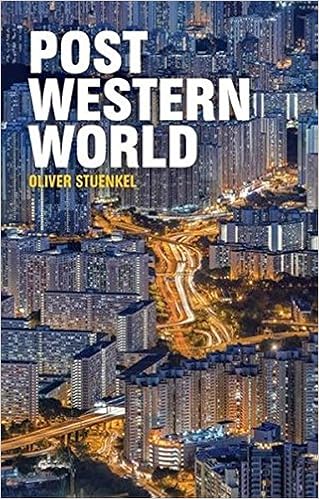
In his book Post-Western World. How Emerging Powers are Remaking Global Order, Oliver Stuenkel introduces some innovative arguments regarding the future of world politics from a quite uncommon perspective for Western mainstream analyses. The chief thesis of the research claims that the understanding of the creation of today’s international order is limited, since it depicts a post-Western world from a closed-minded Western-centric standpoint. In this context, non-Western actors are barely perceived as constructive rule-makers and institution-builders, because the West is widely conceived as the sole actor entitled to enhance the norms by which the international system is disciplined. However, Stuenkel suggests that the study of the future’s world order needs to undertake the inevitability of a bipolarization between the United States and China or even of a multipolarization due to the emerging of the BRICS countries. The end of the unipolar world – which represents a historical fact – implies a more overarching international analysis that overcomes the traditional Western-centric perspective and a more balanced reading of the distribution of global power. The chief aim of Stuenkel’s work is to show on one hand that most observers – both Western and anti-Western – tend to exaggerate the role the West has played in the past and, on the other, to discuss on how to adapt to a multipolar world order.   
The book is organized in six chapters. The first chapter considers the origins of Western-centrism from a historical outlook. Specifically, it describes the nature of global order prior to the rise of the West, claiming that an international order was already in place before; it analyzes how Europe began to advance and rapidly overcome other actors starting from the 16th century, ultimately dominating the world four centuries later; and it evaluates how Europeans – and Westerners in general – believe that Westernization and modernization are synonyms.
The second chapter deals with the rise of the rest and with the likely end of the unipolar system. The principal statement here is that in the coming decades the world will face a condition of “asymmetric bipolarity” in which the United States will keep their leading position in terms of military power, whereas China will embody the world’s first economy. Nevertheless, the author questions whether this kind of bipolar system will be peaceful, durable and stable, but he also rejects the idea – often shared in the West – that the imminent post-unipolar world will be necessarily chaotic and instable. The third chapter examines soft power. After highlighting that soft power uses attraction and persuasion rather than force and coercion in foreign policy, and that its allure relies on a country’s culture, political ideals and policies, the author states that emerging powers are seeking to transform hard power into soft power by implementing three key areas: cultural diplomacy, international legitimacy/agenda-setting capacity, and attraction of each society.
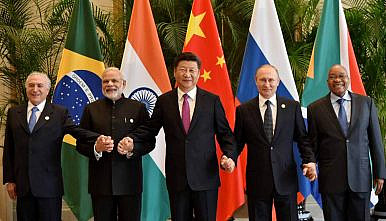
The fourth and fifth chapters illustrate the main international initiatives and institutions proposed by non-Western countries – particularly China – aimed at crafting a parallel global order. These institutions and international regimes are divided into several sectors: finance, trade and investment, security, diplomacy, and infrastructure. The finance sector includes the analysis of the Asian Infrastructure Investment Bank (AIIB), the BRICS-led New Development Bank (NDB), the BRICS Contingency Reserve Agreement (CRA), the global infrastructure to internationalize the yuan, China International payment system (CIPS), China Union Pay, the Shanghai Global Financial Center (GFC), the Universal Credit Rating Group, the Chiang Mai Initiative Multilateral (CMIM), the ASEAN+3, and the ASEAN+3 Macroeconomic Research Office (AMRO). The trade and investment sector analyzes the Regional Comprehensive Economic Partnership (RCEP) and the Free Trade Area of the Asia Pacific (FTAAP). The security sector deals with the Conference on Interaction and Confidence Building Measures in Asia (CICA), the Shanghai Cooperation Organization (SCO), and the BRICS national security advisors (NSA) meeting. The diplomacy sector includes the BRICS Leaders Summits, the BRICS and IBSA working groups, and the Boao Forum for Asia (BFA). Finally, the infrastructure sector introduces the projects of the Silk Road Fund/One Road-One Belt (OBOR), the Nicaragua Canal, and the Trans-Amazonian Railway.
Finally, the sixth chapter draws some conclusions on the coming post-Western world. A key thesis by the author is that non-Western actors do not seek to undermine Western institutions and create a new world order, but rather they wish to forge parallel institutions that emulate Western leadership. Moreover, emerging powers do not question the foundations of Western liberal order, and agree with issues such as international institutions, cooperative security, democratic community, collective problem solving, shared sovereignty, and the rule of law: in fact, all these elements are necessary for rising powers to develop economically.            
The key arguments of the book are the following. First, a Western-centric worldview leads to underestimate the role of non-Western actors have played in the past and play in contemporary international politics, but also the constructive role they are likely to play in the future. The book argues that a post-Western order will not necessarily be more violent than today’s global order.
Second, the economic rise of the rest, specifically China, will allow it to enhance its military capacity and it will inevitably entail an increase of its international influence and soft power – since soft power is easy to generate from a large hard power base.
Third, emerging powers are crafting a parallel international order, with several institutions and international regimes that represent an alternative to Western-led ones. The book argues that, rather than directly confronting existing institutions, rising powers – primarily China – are quietly building a parallel global order that will initially complement today’s international institutions.
Finally, the creation of new parallel institutions is the main strategy that non-Western actors use to better project their power. This alternative order is already in the making, but its structures do not emerge because China and others bear new ideas on how to address global challenges, but rather they create them to project their power, emulating what the West has already done before. The book claims that, as part of a heading strategy, China-led emerging powers will continue to invest in existing institutions and embrace most elements of today’s “liberal hierarchical order”, but they will seek to obtain the “hegemonic principles” so far only enjoyed by the United States. The creation of several China-centric institutions will allow China to embrace its own type of competitive multilateralism, picking and choosing among flexible frameworks, in accordance with its national interests, thus slowly institutionalizing its own exceptionalism and enhancing its policies autonomously by becoming increasingly immune to Western threats of exclusion.
In conclusion, Oliver Stuenkel depicts an interesting future scenario by using lenses that see beyond Western-centric rhetoric, giving for granted the rise of a post-unipolar – and thus post-Western – global order. Being a Brazilian scholar – therefore a citizen of one of the BRICS –, the author points out a very detailed analysis of the main issues that emerging powers will have to deal with, which are often miscalculated in Western academic and intellectual environments. Overall, his book is a valuable and appreciable tool to understand the perception that the non-Western world has of itself and of the West, and, mostly, a useful guide for the West to not overestimate itself and underestimate the rest.     

Risultati immagini per postwestern world stuenkel


References:

O. Stuenkel, Post-Western World. How Emerging Powers are Remaking Global Order, Cambridge: Polity Press, 2016. 

venerdì 23 gennaio 2015

The struggle for natural resources in a demographically overcrowded planet: are we facing the threat of a new World War?

Contemporary global society is living an extremely delicate moment of its existence due to the fact that unlike other previous periods of history all international challenges are not just uniquely limited to a certain area of the planet, but instead significantly bear a worldwide range. Amongst many, one of the challenges is the issue of natural resources demand and supply. This problem originates from the unfair relationship between possession and control of natural resources by a number of States on one side, and demands and needs of the ever growing population of the world, especially in newly developing countries and economies, on the other. Unfortunately, the distribution of natural resources is unequally spread throughout the world and this is clearly highlighted when considering the demographic strengthening and economic growth of emerging countries, which imply a broader use of food and energetic resources, over demographic low-rate and economic stagnation of many developed ones.
Firstly, a natural resource frequently responsible for the outbreak of international and humanitarian crises is water. Water is perhaps is the most precious resource and its supply is often uncertain. Many countries lack of a decent supply in order to satisfy the needs of their own population. Economic growth and industrial production rely on the availability of water. Countries that lack of hydric supply are mostly the African and Asian ones. Those that instead have a greater access to water tend to plan a hydro-geopolitical strategy often conceived as a tool for threatening neighbours or dominate over them. In terms of comparison between developed and developing economies, water is still much wasted in the formers whereas it is beginning to be exploited in an exaggerate manner in the latters.
Secondly, other natural resources of high importance are both oil and natural gas. Contemporary global economies still rely their growth and productivity on oil and gas exploitation. Some of the harshest international crises imply the use and furniture of these two key resources: conflicts in the Middle East, tensions between the Russian Federation and the European Union and the United States, the quick development of BRIC countries and their impact on environmental sustainability, and so forth.
Thirdly, food is to be acknowledged as another natural resource that, if lacking, is capable of strengthening social clashes between developed and developing countries. It is a sad datum to consider that over two-thirds of the world’s population still has insufficient access to food.
Finally, it is worth underlining that uranium is another key resource through its enrichment and use both in civilian and military fields. Some emerging countries like Iran and Northern Korea consider the production of nuclear energy an undeniable right in order to carry out their social growth, whereas Western countries consider such plans as menacing the world’s security and peace.
Despite the difficulties, in the last years the international community has been trying to enforce important initiatives to conciliate natural exploitation and fair treatment for all States and peoples. Multilateral diplomacy has been focusing its attention on studying strategic plans on the subject. For instance, the United Nations approved an ambitious plan to eradicate extreme poverty and to guarantee a more fair access to resources through the Millenium Development Goals. At the same time UN agencies such as FAO and the WFP have contributed to help poor countries in obtaining food and water supply; UNCTAD acted in a similar way too. Moreover, economic international institutions organisations like the IMF and the WB have approved several initiatives to reduce the poverty gap amongst countries through the Poverty Reduction Strategy Papers, the Assistance Development Framework, the humanitarian aid. The European Union as well has strengthened her links with ACP countries (i.e. former European colonies in African, Caribbean and Pacific area) with the creation of free trade agreements. Furthermore, important agencies like the UN Committee of International Law or the Council of Europe have elaborated numerous conventions and protocols on environmental exploitation and ecological sustainability, concerning the sovereignty on natural resources and their utilization, recalling the priority of sharing and cooperating.

In conclusion, the international community cannot ignore that the emerging of highly populated countries like China, India or Brazil rejuvenates and nourishes the issue of resource distribution. What should be clear and desirable is that this challenge will be ever more debated and considered through multilateral diplomatic procedures, activating all the tools available to find common solutions respectful of ecological sustainability and human rights. The omission of a diplomatic dialogue could quickly lead the major military powers of the world in the need of solving the dispute over resources through the use of military might. Could the reason for the break out of World War Three be the resource supply?

The end of the unipolar world and the beginning of the pan-regional world


The beginning of the twenty-first century, inaugurated with the terrorist attacks of 9/11 against the United States mainland, marked a milestone in forging a new order, or system, amongst international relations. Since the dissolution of the Soviet Union back in 1991 the world was hegemonized by the only superpower that could still be considered as the victor over all other rivals and enemies throughout the twentieth century, the United States. However this planetary hegemony, which implied the right for this country to intervene, either directly or indirectly, in political crises in almost any other country worldwide along with the partners of the Atlantic Alliance, declined in the last fifteen years and it is not utopian to believe that its fate will be that of disappearing within few decades. The reasons of the decline and presumable final fall of the American “empire” is to be found in many causes, but the main cause is perhaps the emerging of new economies, countries and powers. Globalization implied benefits in linking together different peoples and nations, however it also made it possible for underdeveloped or medium-developed countries to gain the skills to emulate and ultimately overtake the developed ones, mainly the USA and the member States of the EU. What the international community is facing today is a shift of power from old holders to newly arrived actors, which once and for all decided to raise up their heads.
Shift of powers in anti-American, or, best to say, in anti-Western key are emerging somehow in all places. First of all in the Islamic world integralist groups and organisations are decided to accomplish the great plan that the first Muslims close to the Prophet Muhammad considered fundamental to accomplish, to free the lands upon which Islam desired control from the dominion of infidels. The Islamic community, especially the Arab nations that embrace Islam, know well their history and can see that the Islamic world was obliged to hold a defensive position facing the “Christian” nations since the decline of the Ottoman empire. Arabs feel as they are the great losers of the present world order, having suffered under the colonization of European States, having lost at the time of their independence the opportunity of forming a pan-Arabian State and most of all having been humiliated by the Zionist movement with the creation, in the heart of the Islamic world, of the State of Israel. If we focus on the so called terroristic organizations we can realize that after all they are fighting a defensive war against infidel intruders or against puppet governments that support infidel States and powers. The reason of the proliferation of jihadist  movements is that Islam, the real and integral one, feels that the showdown against its enemies is near and that sooner or later a shift of power will occur from the Western liberal “atheist” democracies to purer and God-fearing political organizations. The strength of Muslim faith relies today mainly in the demographic factor, which makes Islamic countries some of the most populous of the world, and in the strong immigration of Muslim people especially within Western countries in which integralists could act as fifth columns.
Secondly, we can perceive a shift of power in Eurasia, where new countries are combining their strength to counterbalance Western hegemony. First of all, once ending the humbling age of Eltsin, Putin’s Russia has raised up its head and is willing to gain the leadership of the Eurasian continent in the next decades. Russia indeed has everything: natural resources of all kinds, enormous land,  sufficient manpower and the strategic position of being a natural connection for the Western and the Eastern world. Russian lands begin in Europe and end in the Pacific Ocean and Russian national interests cover all continents. It is possible to admit that we are living a continuation of the “Great Game” that the Russian empire and the British one fought throughout Eurasia in the nineteenth century, although nowadays the Russian rivals of the game are the United States on one side and the European Union on the other. But Russia is not fighting alone for hegemony in Eurasia: China is her best partner in the pursue of creating this shift of power, realizing that a partnership with Russia is a safe way to obtain a long-term furniture of key natural resources, mandatory for an ever growing economy and population. While the European Union, with Washington’s support, is trying to extend more and more its influence over nations which traditionally were under Russian or Soviet influence (Ukraine, the Baltic area, the Balkans, the Caucasus), Russia is answering trying to confirm once again that these areas are under her control. As we could see in the past years this contraposition between EU and Russia brought to the break out of regional conflicts in several “border” areas: Kosovo, Georgia, Ukraine, etc. It is foreseeable that the victor for hegemony over Eurasia will be Russia, and this is due to the fact of its inner strength and autonomy, to the clear weakness of the EU and skepticism towards her amongst her very citizens, to the key alliance with strong actors like China and less strong but still regionally important like Kazakhstan, Belarus, Serbia, etc.
Moreover, we can see that a shift of political power implies also a shift of economic one. How can it be that the strongest economy of the world, the American, is also the most highly indebted? A country cannot base its existence on ever growing public debt. On the contrary, other countries like China prefer to count on economic savings and sustaining of foreign sovereign debts. New economies are growing faster than expected: Russia, China, India, Brazil, Mexico, Iran. The developing of these so called BRIC countries will clearly imply a resizing of the American economic might: this could lead to the end of the role of the US dollar as main currency used for economic transactions and to the obsolescence of the international financial institutions headed by American capitals (World Bank, International Monetary Fund) which may be soon substituted with others entirely funded by BRIC economies.

In conclusion we can say that international relations are facing a real revolution. The decline of the unipolar world hegemonized by the United States and its NATO allies seems to be not only possible, but already a concrete matter of fact. It is clear enough that our world is running faster and faster towards a multipolar community in which strong or medium powers are gaining a regional control, or best to say a pan-regional control, on which they can act as only leaders. In other words Haushofer’s geopolitical vision is closer today than ever, but if at his time the plan failed for the results of the second world war, today no superpower is sufficiently strong for avoiding its success.                                               
Related Posts Plugin for WordPress, Blogger...